

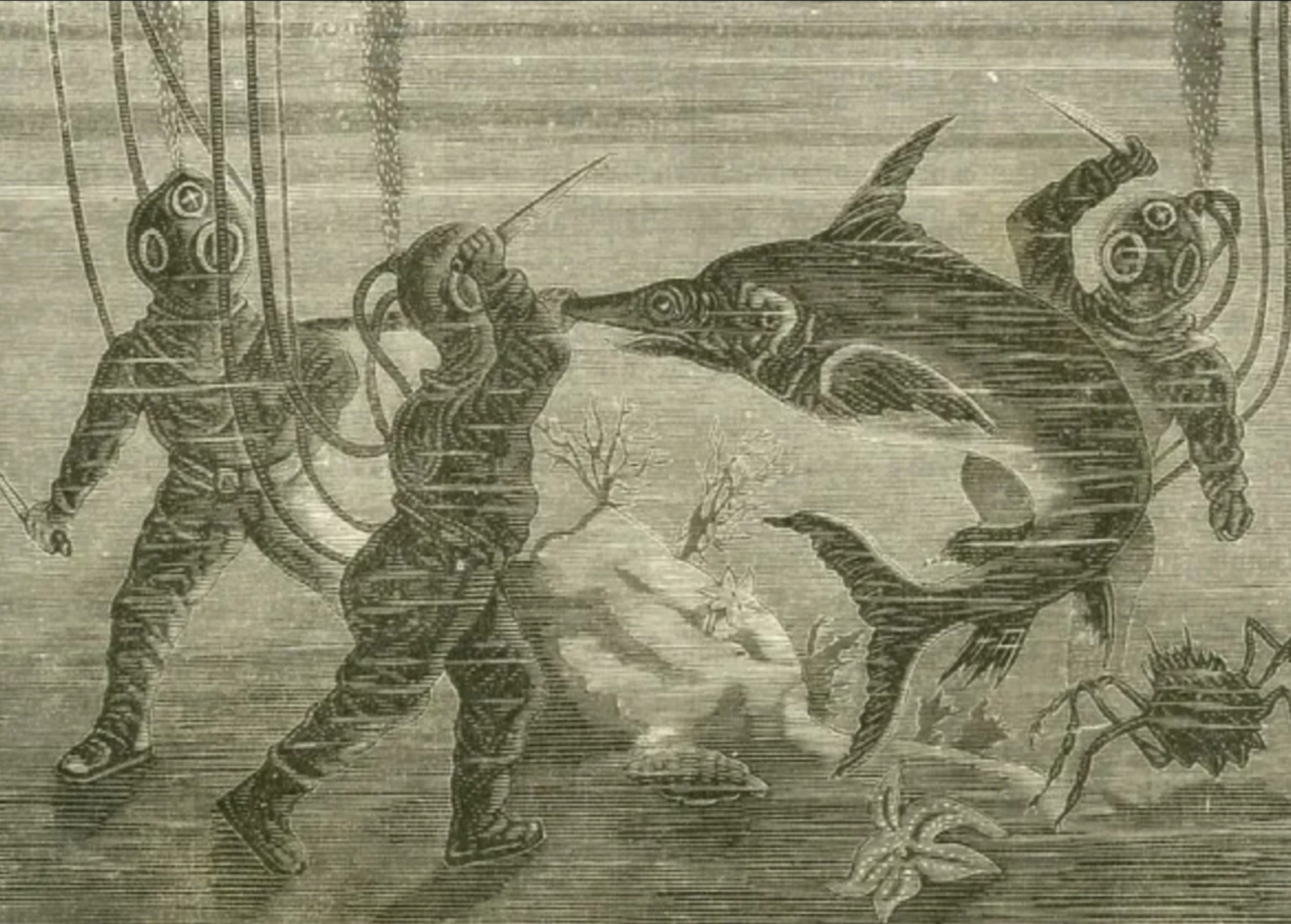
I am a fan of helping people upgrade their skills. That’s part of the purpose of this blog. Along these lines, let me tell you why you, the sex god, and every sex god and goddess in your life should consider having the experience of scuba diving, both on its own terms and to add to your sex-body-nature experience points.
**Note that the *should* there is completely optional, and you must always consider your own health and circumstances for if this makes sense to you.
It heightens your relationship to your body in a way nothing else does
What is so great about diving?
Ah! So many things! One thing that I didn’t know about at all was that the breathing underwater is so cool. Of course it is cool as an extension of the human body, in the way that being able to fly is cool. Being able to do something you naturally cannot do is awesome.
But there is another element to the awesomeness which is the way that being in a new environment changes and heightens your own relationship to your own body. You become more of your body by testing it in a new environment and feeling it differently from how you were accustomed to feeling it.
You get way more in touch with your own breath because now your breath controls your location in your environment, and so the granularity of control you have over your breath corresponds to pretty big movements in real life (sometimes feet). Your breath is now like a video game controller moving you around.
The training does teach you to move up and down using your own breath alone to save energy swimming, because it is so much more effective. You don’t swim up or down — you swim side to side, but up and down it’s all just breath control. Breathe in, and you move up, breathe out, and you move down, because the volume of your lungs changes and thus the relative density of your body compared to the surrounding water affects your buoyancy. It’s a kind of connectedness to the body I haven’t experienced anywhere else.
It is easier and cheaper than you think
Diving is a lot easier and cheaper than its reputation. It is in the category of “expensive hobbies,” but that is if you are independently traveling just for the diving and are buying and maintaining your own equipment. However, most people who are casual divers go diving when they are traveling anyway for other reasons, and they check out the PADI center there and buy a spot on an excursion. Then they show up at a location, the center gives you equipment when you so you don’t have to buy your own, you get on a boat or walk a bit, and you go diving.
This way of diving is very safe. The equipment gets maintained by professionals, to standards, and gets inspected. The divers know the area and the types of currents that show up there, and you would be going with other people. Most of the injuries and fatalities you might hear about that involve diving include people diving in unknown conditions, people diving in an unknown place, people diving alone or with only one other person, or people diving in caves, such that they cannot follow a relatively simple set of actions for rising carefully up to the surface to get air if something is wrong.
PADI is the Professional Association of Diving Instructors, which is the largest scuba diving training organization in the world. There are some competitor schools that exist, but because of the way patents and intellectual property work, they make small changes to their equipment and training that are actually suboptimal. Basically every place that you can dive will have a PADI center, which is not true about the other schools. So PADI is probably your best bet.
Diving is a bit expensive, but not impossibly so, and it is actually pretty accessible to most people. In fact, many diving instructors and divers make a pretty modest living. They just really like being outside and diving.
There are places in the U.S. and around the world that let you do a few dives without a certification, to see if you like it, generally for less than a few hundred dollars. (It is the price of going on the boat and then for the equipment and the guide.) I would recommend doing this to see if you like it.
Generally, getting the basic certification is the next step because it allows you to go on most excursions with most groups in most places. This certification also lets you go without a guide (but with a buddy), but you wouldn’t want to do that. The centers meanwhile want to check if you have a PADI card because they would not be doing the full training with each person who books a trip (though they would do a short review) because doing the full training takes a while.
The full Open Water training usually is less than $500, and includes a course you complete independently online on your computer or iPad that teaches you the material (this takes about 10 hours), followed by a few days of practicing in a pool with a certified trainer, followed by your first few dives in the ocean. The price varies a bit by location. For example, if you get certified in Mexico, chances are that you will get a cheaper deal on the training portion because pay and cost of living are generally lower there.
When you consider the per-hour rate on the experienced trainer’s time, it’s not a bad deal.
What is cool about it is that this is all you need. (This is the PADI Open Water Diver Certification, open water meaning you can go into the ocean.) It is straightforward, and all the material is included in the course or in person by the trainer. You don’t have to learn any of your own material or read any additional books. It is streamlined and straightforward in this sense.
Then, you can go to any PADI center in the world and go on whatever dives are on offer, and they will let you go. You will have between one to four very experienced divers on average on your excursion, and a few other people with you in a group. This makes diving much safer, because the center maintains the equipment that it rents to you to use according to their standards, and going with many people is much safer than going alone or with just one person. If something goes wrong, you use hand signals to show somebody that you cannot breathe, and every tank has two regulators attached to it (the round thing you breathe from) and so if something happens to one of yours, you have a backup, and if something happens to the backup, everyone gets trained in how to swim over and give you one of theirs. The guides would be very experienced in this.
You learn about an entire new world of animal behavior
What else is awesome about it? You see all the natural fish behavior. You see how the schools of fish swim together and avoid schools of entirely different fish. They look like they are on a mission, like they are doing some kinds of errands and going about their day. This is different from how they behave in an aquarium.
You see how the different species interact, how the fish live in the corals. You can book excursions to do a tour of the really big fish. To see whale sharks, the biggest fish in the world, you only need to go to Cancun. You only need a snorkel for them, not diving equipment, because they swim near the surface. They are fish, not mammals, so they can get frightened occasionally, and then dive down really deep out of sight. You don’t want to follow them down.
And then the Manta Rays are so beautiful in Hawaii. You go down about 20 feet and then hold a rock in the sand on the bottom, in a circle around a splattering of krill that they shoot up. The Manta Rays come and they dance and feast. And this visual and experience is much different from how you might see them on the surface, where you just see their wide white bodies. Under the water you see them swimming with each other in their geometric patterns, around each other, not touching each other or you because they are using electricity to sense everything. You can see their entire dance as they eat the krill and you are holding onto your rock and breathing underwater.
Who should and shouldn’t do it?
Who is a diving license good for? I believe it is a pivotal experience for people who are into meditation, want to expand their sense of agency, or want to expand their sense of body awareness. People who invest in going to Burning Man, sign up for meditation retreats, and travel abroad often to have unique experiences may benefit from additionally having a diving certification.
Of course, it is also for the people who love fish and animals, and like to see them in the wild in their environment, and see what they are up to and how they live.
For people who already travel abroad a lot, they can add to their itinerary a diving adventure every time they go somewhere, with only a day or two’s notice sometimes, and over time, they easily would have been diving all around the world!
It also isn’t just for adrenaline junkies. I am not an adrenaline junky (skydiving does not appeal to me, and every time I’d jumped off a cliff I didn’t like it). What I like about scuba diving is the presence of bodily control and mastery of your environment, not the absence of control.
Who is it not good for?
If you hate fish.
If you already know you hate water and hate being in the water.
If you have a lot of medical issues that prevent you from doing physical activity. (If you can’t go on a hike, you probably can’t go diving, but if you can go on a long hike up hills, or with rocks, you can almost certainly also go diving even if you feel out of shape. The tanks are heavy, but you wear them on your back and do not have to carry them much with your arms. And then on your back they are lighter, and in the water they are much lighter. And then you can also have someone help you carry them when you do have to move them with your arms.
If you hate moving at all.
If you hate spending time in boats. Some people get sea sick. There is medicine you can take for this, so if you haven’t tried the medicine I wouldn’t rule it out. But not all diving you need to go on a boat for. Some you can go out on a pier, or walk out into a reef. But some diving you take a boat onto.
If you can’t equalize your ears. This is essential — if you can’t equalize your ears, when you go underwater, the pressure will be too high and you will experience immediate pain even just a few feet under the water. Then you will get badly injured very quickly if you don’t go back up – there is not way to just deal with the pain and push through it, it will actually be unbearable basically immediately and keep getting worse when the pressure gets too high and you do not equalize it.
When I went diving for the first time, I thought that I wouldn’t be able to go because I couldn’t equalize my ears. The tip I got was to “pretend I’m blowing my nose” – and then actually to blow my nose. I really couldn’t do it. The instructor asked me if I want to keep trying, or if I want to sit out. Then I had a thought, “What if I pretend I am sneezing? Is that a more advanced form of blowing your nose?” and then I did that and it worked! And then that imagery worked consistently for all my time diving. Different images work for different people, and if you don’t get it initially, don’t give up, unless you genuinely think there is a medical reason for it. There may be some other trick that allows you to do it.
I consider diving to be an attainable and straightforward way to do something really magical. It is something that could be very difficult and confusing, but a lot of people put a lot of effort into making it safe, affordable, and something you can do without too much additional trouble when you are traveling. I recommend it to everybody who has any sliver of interest in it, to go ahead and do it whenever it is convenient to get started!