

If you watch the show “Blown Away” on Netflix, you watch professional glassblowers compete for $10,000 plus a residency in Corning. A relatively low cash price, but glass blowers are used to not making very much, and given the steep learning curve for this art form, are very committed regardless. A residency in Corning, however, as the world’s mecca of glassblowing, is a very big deal—a bigger deal than the cash, to be able to work comfortable at state-of-the art facilities and with world class support.
I had heard of Corning. I had spent time in upstate New York, and so it was a name I had heard of, like “Utica” or “Horseheads” or “Coxsackie.”
I did not know that Corning had the largest glass museum in the world, and so I went to there.
What is interesting about intricate glass objects is that they become unphotographable. The light does not reflect properly at all. It goes in all directions, in interesting ways.
This is in contrast with the crispness and beauty of the show! Of course, a lot of glass is photographable, especially with the cameras that Netflix has. The show also captures pretty well the pacing that goes into making something if you were to for example take a class in Seattle (another mecca of glassblowing, like Corning) or Florida (which is not a mecca of glassblowing but is Florida and so has everything). The space is cramped, you have a small amount of time to do anything, and the glass is really hot and I suppose the people who know they are clumsy know not to get into this hobby because you can really hurt yourself.
A lot about the art and craft of glassblowing did end up getting captured by the Netflix show. If you go to the Chihuly museum of glass in Seattle, and take photos and buy postcards, you will see that the beautiful colors do get captured very nicely by your phone camera, and sometimes the colors are even more vibrant in good photos than in your eye in the original lighting. The contrast and accents get augmented.
Given all this colorful splendor, for a while I forgot about this idea—that there should exist glass that is either impossible or very very had to photograph.
And so finding uphotographable objects yesterday felt special.
It felt like a hypothesis about reality was confirmed.
Behold, this furry cube.
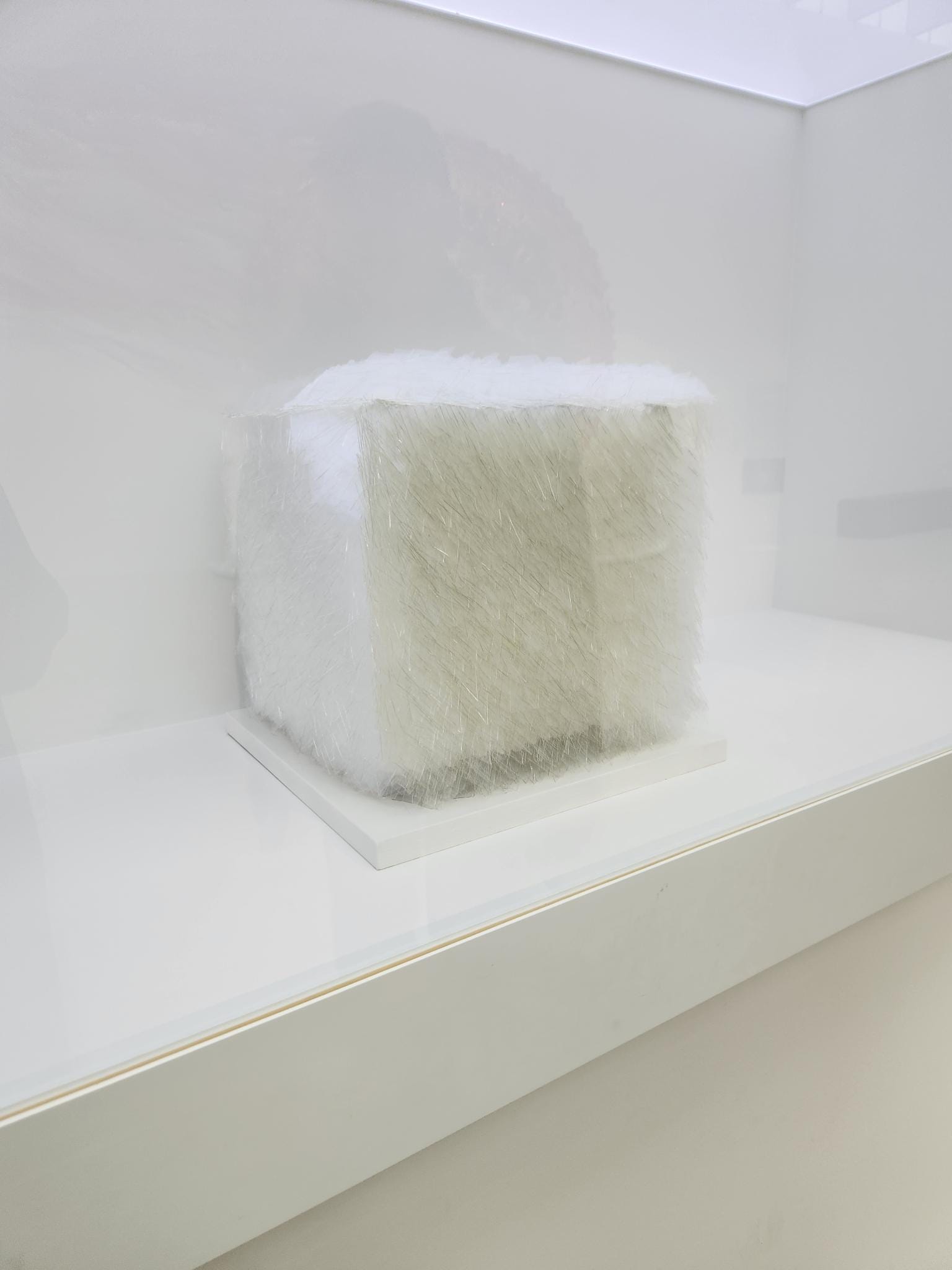
Behold this adorable glass marshmallow. Notice that the image is not blurry. There are crisp lines in the photograph. The cube is blurry. It is blurry because it is made of many small, long pieces of glass and each piece reflects light in a different direction. In the photograph it is blurry, and you do get the impression that glass was made to look soft in an interesting way.
In real life, the effect was profound: it looks fluffy and soft and magical.
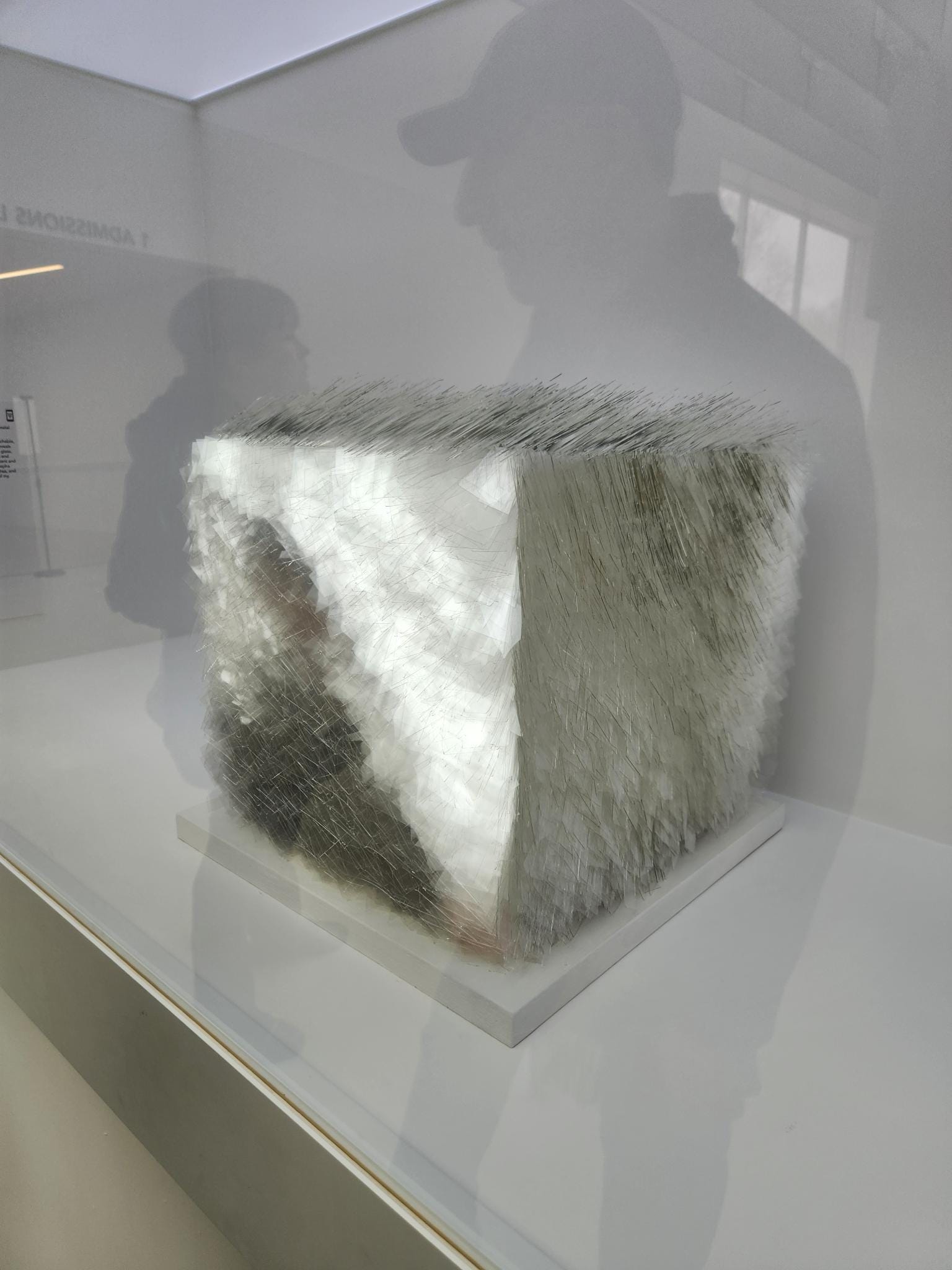
The same cube from another angle. You can see that now from this angle it looks very different. It looks hard and sharp, metallic. The first photo had more of the right “eye-ASMR-feel” of what it looks like in real life even though it is blurry. This photo is sharper, but you can’t really see how soft and pretty the cube is here.
If I could buy this cube to look at all the time, I would, but they will not sell me the cube.
The other favorite object of mine from this museum was this glass fish tank of beautiful otherworldly alien hermit-crab trombone-faced lovers. I also would like to buy it to look at all the time, but they will not sell to me this fish tank.
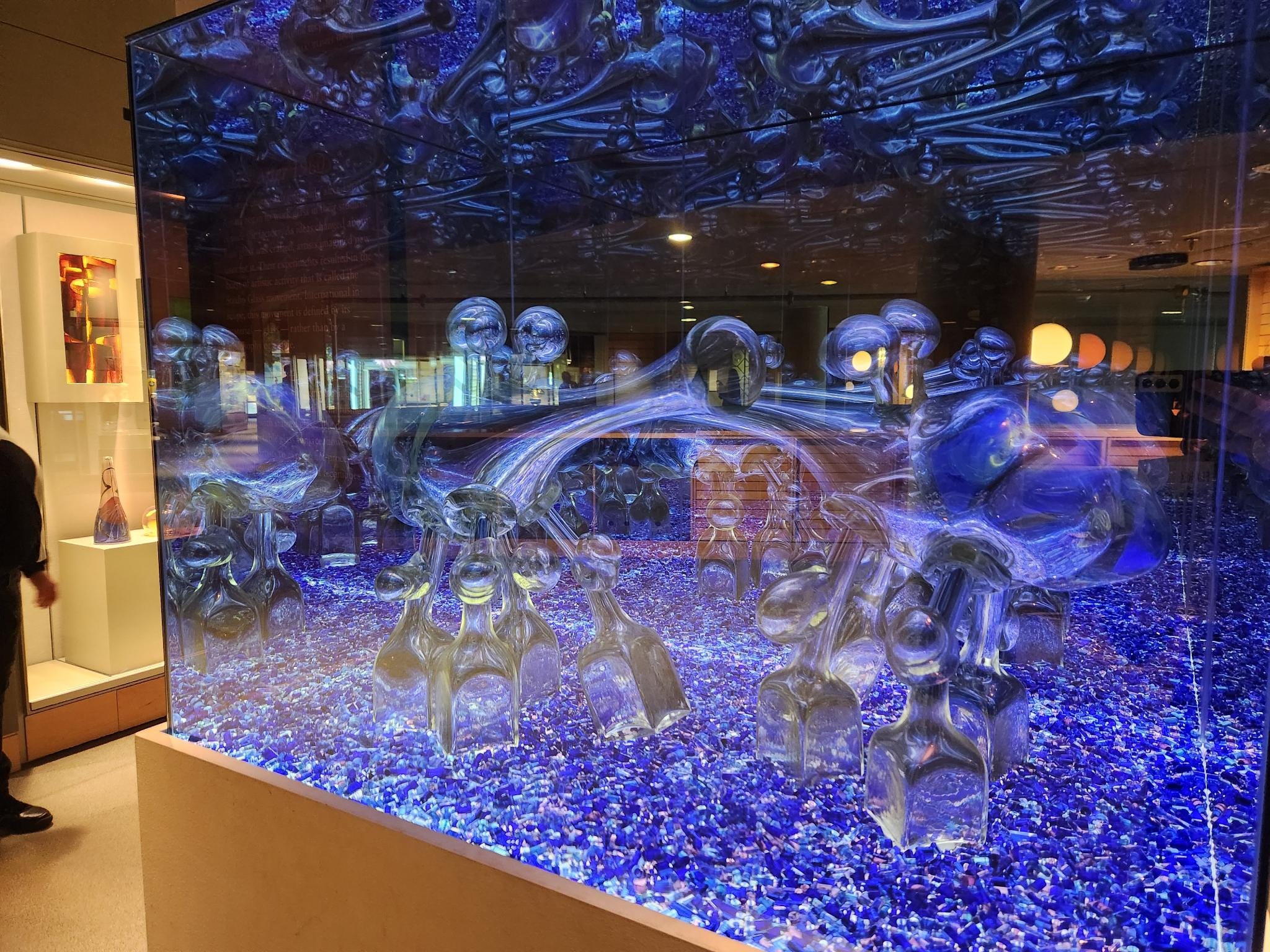
When you find the corners of the tank and account for the depth perception, you can make out what it is supposed to be. But again, the photo doesn’t completely look like the way it looks like in real life.
Given the state of James Cameron’s tech, there certainly exist cameras that would capture what is most beautiful about it, but my phone was not able to do it.
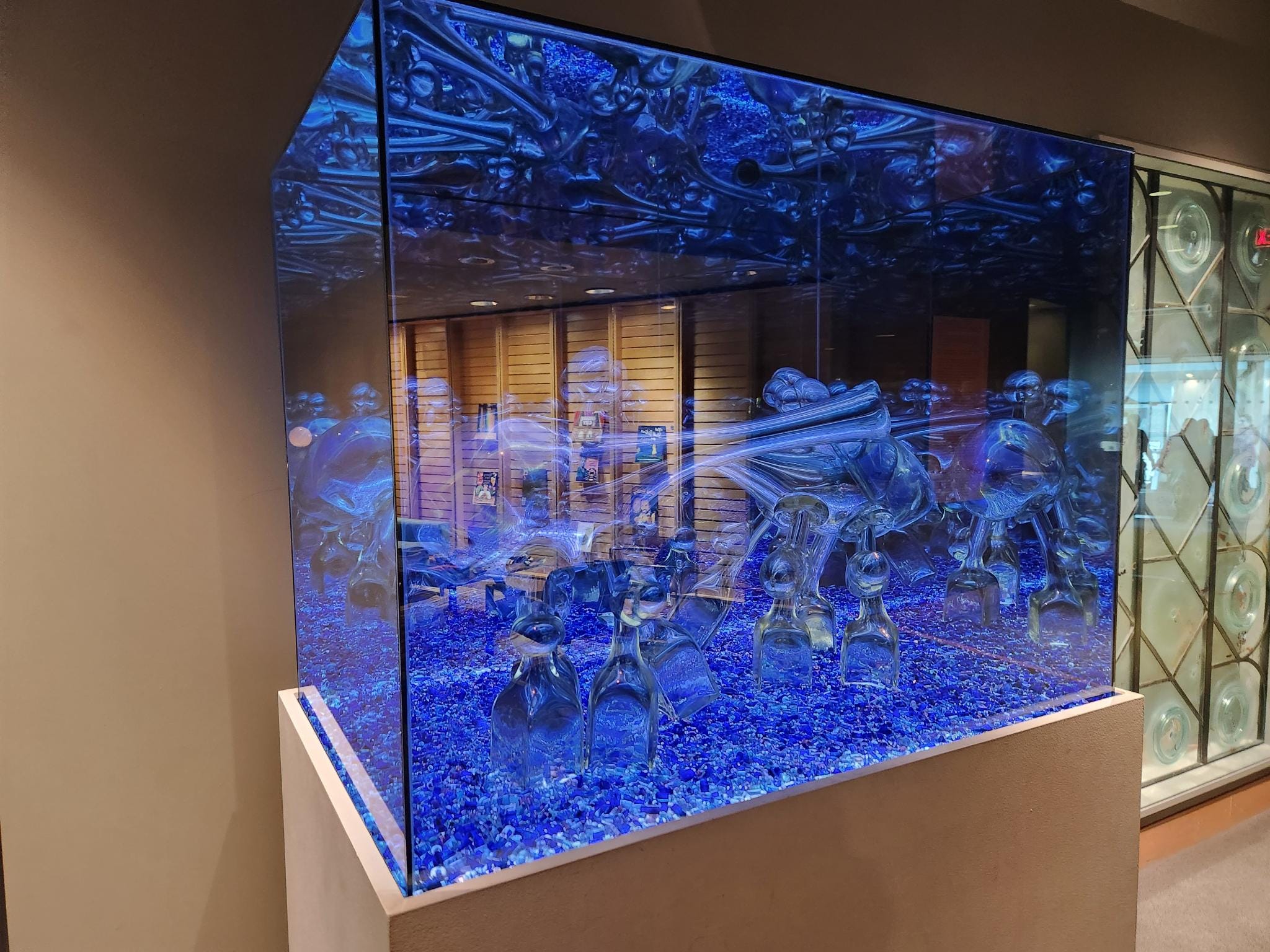
Even an excellent still photo would not capture what it is like to stand there in front of it. In real life the light bounces around and changes as you move, and the light is also in the room with you and so you can feel it. It is telling that in some of the professional photos of this piece, the tank does not look blue; the colors are completely different.
I think we are used to the idea that in person there are many other senses involved when you are in a room with an object. You can hear things, smell things, touch things, feel the energy of different things. But that there is still uncharted terrain in the area of what you “see” is also very nice to notice — to see glass arranged in such a way that the light bounces in such stellar ways that you can only experience in the room.
The details for the cube:
Name: 30/06/2007
Artist: Josepha Gasch-Muche (German, b. 1944)
Made From: Borosilicate Glass, Adhesive, Metal, Wood
Date: 2007
Place Made: Germany, Alfeld
Link to museum pageInterpretive Notes:
"Gasch-Muche was trained in painting and drawing, but in recent years she has worked primarily with broken glass. She believes that every material, regardless of whether it is naturally or industrially produced, has its own inherent structure and texture waiting to be given form. “I did not discover glass,” she says. “It discovered me, and it opened up the possibility of painting with light."
The details for (what I call) the hermit crab tank:
Name: Ghost Walk under Infinite Darkness
Artist: Andrew K. Erdos (American, b. 1985)
Assistant: Lorin Silverman (American, b. 1987)
Studio: (glass) Studio of The Corning Museum of Glass
Made From: Glass, Dichroic Glass, Mirror, LED, Wood
Date: 2013
Link to celebratory commission page
Link to museum page
Interpretive Notes:
"When all your senses are activated is oftentimes when there is a moment of clarity." – Andrew Erdos The New York–based artist Andrew Erdos combines glass sculpture, video, performance, and sound to explore the intersection of culture, technology, and nature. He says, “In my work, there is a complex series of relationships happening; I am trying to explore all the possible caveats of an idea.” Erdos’s art is pop, sarcastic, and bold in the sense that it is fearless. He uses traditional glassblowing techniques and well-known glass effects—such as the infinity mirror—to create distinctive, nontraditional environments and narratives. In this sculpture, a two-way mirrored box contains fantastic beings blown out of mirrored glass, with applied glass bits that have an iridescent coating, which is called dichroic glass. Erdos chose not to include video, which he often uses to infuse light and color into an environment. Instead, he combined thousands of pieces of colored murrine with LED light to create a situation of sensory overload, a setting of hyper-beauty. Erdos has always used protagonists in his work. A costumed, anonymous Santalope, a trickster in the form of a hybrid horned Santa, was a character who appeared in Erdos’s early videos. This work was essentially pastoral in nature, reflecting the artist’s location in western New York State. More recently, the urbanized Erdos makes use of a cartoonish, scary-sweet mouselike cybercreature, a fantastic yet naive being, to negotiate a disorienting and visually cacophonous world. It is hard to tell if Erdos is leading the viewer in a direction that is post-apocalyptic or kitsch, and it is this confusion—a clash of opposites—that he exploits in his symbolic narratives. Erdos’s titles often refer to time, ghosts, or nature, and his vision is essentially a dystopian one, but tempered with empathy, humor, and wonder.”