

Most of the books I read these days I read with or for friends. This is a part of my life that I had been liking for a few years. It is rare that I would have to think very hard about what I “could be reading” or “want to be reading.” Something emotionally relevant to me is usually within range, and usually somebody I really like would be happy there is a new person to talk to them about something they like, and the new themes and emotional universes that emerge from that.
House of Leaves was my big book for 2026, in the way that Moby-Dick was my big book for 2025. By “big” I do not mean page count, though both are 500+ pages. I mean challenging for me personally, in some way, such that reading it leads to some personal growth. A “Dark-Souls-esque” book that might take me a few tries to get going and isn’t smooth sailing, but that I had pre-decided is a journey I want to go on.
I was really surprised by this book. It bounced off of me three times, when I tried to read it, before I finally made traction with it, and so I came up with additional prerequisites that would help me.
The first time it bounced because I wasn’t looking for something cold, technical, or particularly postmodern. I was hungry for intense emotions, and my brain wasn’t warmed up for reading this kind of writing. I looked at it, read the “introduction” by Johnny and some of the first chapter, but did not actually understand anything, even at the level of basic things that were happening.
The second time it bounced because I was overwhelmed by early intense and explicitly detailed masculine sexual tropes. “A hooker ‘painting’ the walls with her blood, and a stripper named ‘Thumper’ — not for me.”
The third time, I got through the introduction and got to the Navidson Record, but was very intimidated. What got me over the edge here I couldn’t have predicted. (It was getting bored with the Brothers Karamazov and wanting to read literally anything else).
Some of the prerequisites I did —
I read The Candy House by Jennifer Egan. I was expecting a kind of masculine, technical genius in House of Leaves, and The Candy House is a work of what I may loosely call feminine technical genius, though this is likely an unfair characterization given that “masculine” usually means something like “precise” and The Candy House is a very precise work. The first time I was glancing at HoL I was struck that I may have a longing for a lot of emotionality and predicted that I would be annoyed that this book that is famous for doing a certain specific thing wouldn’t be doing other things — and I worried that this would lead me to an unfair reading. “Wishing a book was another book” is a kind of non-charity that I try to avoid.
Funnily enough, even though The Candy House is a lot shorter, it took me a lot longer to get through. It was emotionally intense in certain ways, and getting through it was good for me. It involved a lot of precision around memory. It took me many months to finish it, even when I was getting into it. It took me about two weeks to finish House of Leaves when I started reading it in earnest.
This is one of the things I like about reading in this way, where if the reading is hard, you do some prerequisites. Often the prerequisites are valuable in themselves, and then you read more instead of being stuck!
The Brothers Karamazov with a reading group also really helped. I thought that I would have to wait until I finished the Brothers K before starting House of Leaves in earnest, or I would get too confused, but I was not liking the Brothers K that much, and wanted other content to triangulate it with. I was also having a harder and harder time reading it, into books 4 and book 5 of Brothers K, and so used that break to read all of House of Leaves.
This was helpful because though the Brothers K seems intimidating because it is Dostoevsky, it is a straightforward novel. It was written as a serial. It’s basically a telenovella. And so that was a good foil for a super normal, non postmodern book to contrast HoL with.
To warm up for the sexual content, the Brothers K helped, I read a bit of Ulysees, and some writing from friends. I had hopes of reading all of Ulysees, but realized that it is often treated as a “reach book” in its own right, a Dark-Souls-esque book, and would take me a long time. The Candy House helped me also in terms of wrapping my mind around Los Angeles-style ennui around sex. Watching Lars von Trier’s Nymphomaniac 1 and 2 was also helpful, as well as centering myself a bit into my own feelings with rewatching a movie involving sex I really really like, The Duke of Burgundy.
This helped me see that things like the “bloody hooker” and “Thumper” were not without some detached irony, and that “reading way too into these things as if this is where the emotional weight is, rather than plot device, because I find it personally new and intense” would be a mistake. And so seeing how other content and other authors play with this stuff and what they’re doing was really good for my reading.
All of these prerequisites were done at my own pace, and with friends. It was a lot of fun and felt like a natural exploration of my interests, with this goal of priming myself for understanding a specific book in mind.
I liked the book a lot more than I thought I would. I thought that, with my preparation and priming, I would appreciate the technical deftness of a genius madman, would not miss the emotional landings of normal books enough to stay focused and finish, would have good conversations with friends, and would respect HoL’s deconstruction of genre.
In fact I ended up just breaking down and sobbing at two specific major emotional points in the book. Just in a pretty normal, “oh my god oh noooo :( ”
I was surprised that my reading involved much less being taken in by any technical deftness and more swept up in the literal content of the book, the images it creates or provokes, and the emotional themes that it brings up.
I am somebody who tends to imagine things when I read (I learned recently that this is not true for everybody). The descriptions of the dark corridors conjured for me literal dark corridors, and then the themes around trauma, grief, and mental illness took me to those locations in myself, and now I am imagining the dark corridors be there, in those sites that the book is pointing me to.
I actually have a lasting impression in myself, after the book, when I am feeling hopelessly dark, in that instead of having a void, that just doesn’t feel like anything, instead I am having those infinitely expanding fractals of corridors and stairwells. Instead of feeling like there’s “nowhere to go” it feels like there are lots of places to go. They’re just dark. I don’t find it an accident that I have been texting a bunch of my group chats pretty dark stuff this week while reading! Feeling out my own expansion into my own darknesses.
I found this to be powerfully healing, and really touching in that the book is about the healing power of books for trauma, and I did feel like I had a big effect on some of my trauma stuff, from this reading.
The poems I found were beautiful. The special house of leaves specific poem I found especially deeply moving and meaningful to me.
Even now I tear up reading it, I don’t know
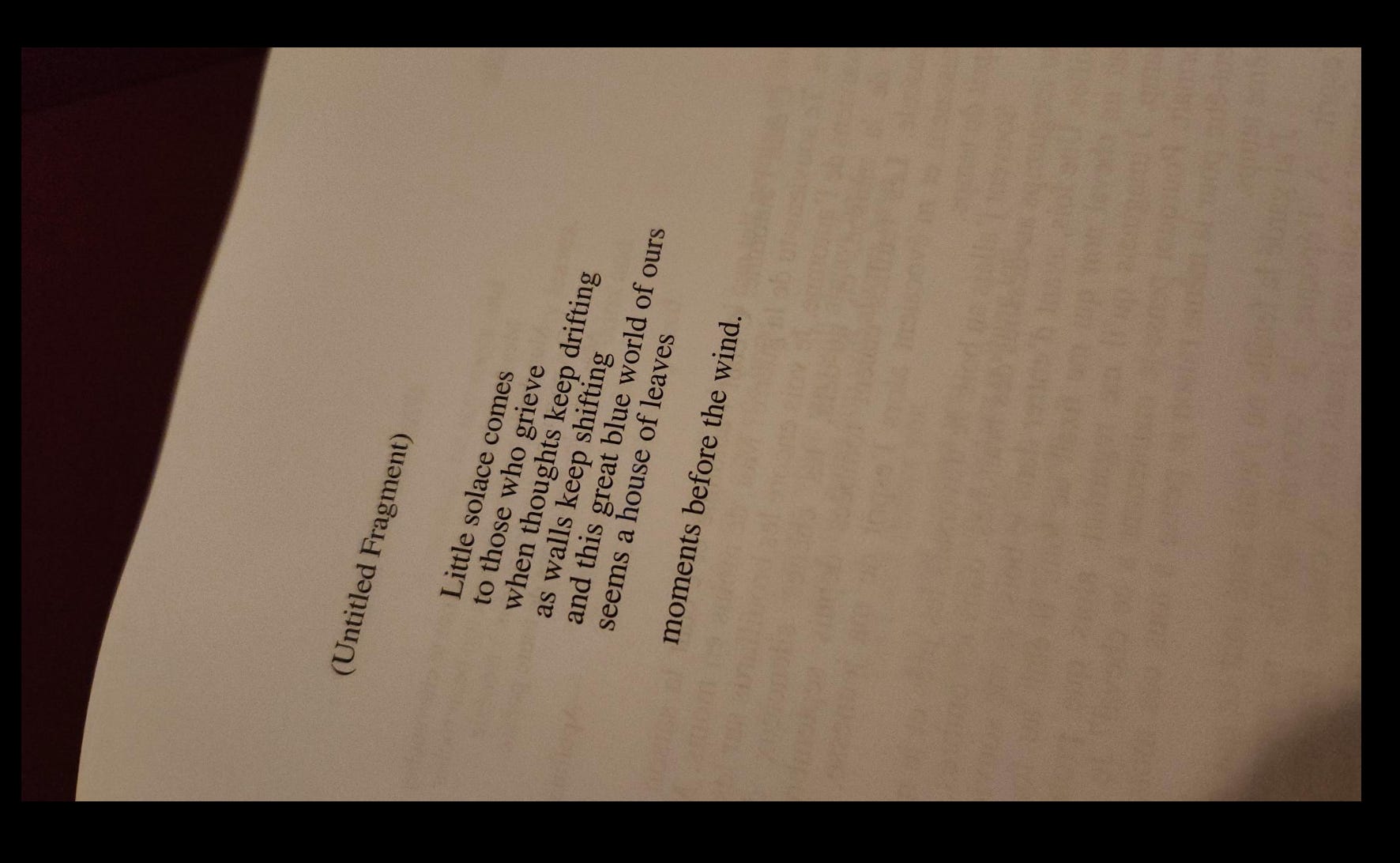
I am glad I primed myself not to be upset by things like “lack of women characters doing stuff” or “showing the internality of characters through dialogue” or “graphic descriptions of the kinds of things men want to do to women when they feel freedom to write about it.”
This let me get through the book
and I was really really moved by it. I found it very tender. I found it really really big in its tenderness.
I think learning about “what the book won’t be” actually disproportionately increased my enjoyment of the book in ways I would not have expected. I did that to curb disappointment, but actually the metacommentary on genre and “what is a book” that HoL does had been supplemented — that is, having built this relationship of things “outside the book” did help me both understand and enjoy what is inside of the book.
I am somebody who in my interpersonal and intimate dealings, has a fiery sunny mode, but also have a moon mode, enneagram 4w5, a little more looking at what’s missing and noticing how that shows what is there, more focused on silences and what breaks the silence…….
And that side of me really appreciated some stuff — a bunch of stuff that might be quieter but felt pretty loud to me, given my buy-in into generally taking myself into colder and smaller places in myself, farther away from the world (potentially my negative schizotypy stuff, derealization, stuff like this). And so from a place like that, dispositionally, and then following what the book is doing, it did lead me to feel a very big expanse of tender warmth around the ending, the last 30 pages.
There was a whole chapter in the book that involved a ton of citations involving things that are not in the book — just hundreds of citations of houses that are not the house in the book
there is a joke in the Index too - there are items in the index that are not in the book - that just say DNE - does not exist? but if you erase the letters DNE from INDEX you get IX which is chapter IX which is the chapter with all the citations of things that are not in the book……
And I think technically I do not usually follow things like this particularly well, tricks like this, but emotionally I did get very involved with this and so got a lot out of it
where I did get really really bought into the book, the story, what will happen to everybody involved.
I bought the setup that Zampanó was writing about a real film, and that the real film actually happened.
That is, enough “disbelief” about Zampanó existing was set up as a premise (who is this guy, why did he leave this manuscript?), and then questions about the film even existing, and then is what happened in the film even real — all these areas of disbelief were fleshed out (and this is one aspect of the technical brilliance that people refer to) — that a certain dance around “actually believing the novel” did indeed happen for me, and I did really care about everyone the way I would be if I was reading a normal novel.
I also decided to have certain buy-in early. For example, I was noticing all the instances of “house” that were in blue — I did not know why, and still do not know. But I had decided that the “house” in “blue” was going to be a magnificent little treat that I am extra emotionally invested in, like of course this is a wonderful thing, that “house” is in blue! as if this is a really important thing. It might be. I wouldn’t know why. But I got really invested in feeling the feelings around having buy-in for that early, as a cool thing, and I think that did give me an emotional foothold for the larger emotional arcs and surprises.
I basically read it in two big chunks. I read it from the beginning, through when they all come back from the house the first time — this took about 7 days. Then I took some time to do some work — a few days. Then I went back and finished the book in a day.
I found the ending of the book to be satisfying. I didn’t expect it to be. I thought that the “first ending, where I first stopped” after everyone returns from the house would be where I actually would feel complete and happy, that intense darkness labyrinth, and that everything afterwards would kind of just be a wind-down. But there was another crescendo and another wave, and that second wave was this big loving wave of warmth I really did not predict would be there, and I found the end to be really quite beautiful. It made me want to read the book again, kind of, but not yet, and maybe only just bits of it, now. I still am thinking about it and am overwhelmed in it, lost in it.
This book did leave me feeling like I would reread large parts of it, and then maybe reread it again in a few years in its entirety. I see how people revisit it.
I also did read it when I was pretty sad and a lot of the emotions in the book resonated with feelings of isolation I was experiencing in my own life.
I think I definitely got smarter reading it. Like probably actually increased an IQ point or two.
Some people talk about getting “lost in it” and that definitely happened to me. I didn’t really want to put it down, but did need emotional breaks. But a reading session for me without a break would be about 2-3 hours, which is long for me.
Still shaking, in a unique way, afterwards
I found it meaningful also that this book is about the death of books as a genre, in the age of digitalization, but also that it is about death literally, in that if you do not read it as a book about it in context of literature but just read it straight up, it still works. I read it more in the spirit of this second way, as a book about grief for people who you love who died, and how to keep living.