

I don’t actually know my favorite movie, but if someone at a party asks me what my favorite movie is I would probably say The Cow.
If you are into something artsy, something that plays with space in a new way, something that teaches you about people, something that actually was considered a masterpiece, this is a great film for you. If you hate subtitles, you don’t really need subtitles to understand it, you can watch it. In fact, I recommend watching it at least one time without subtitles.
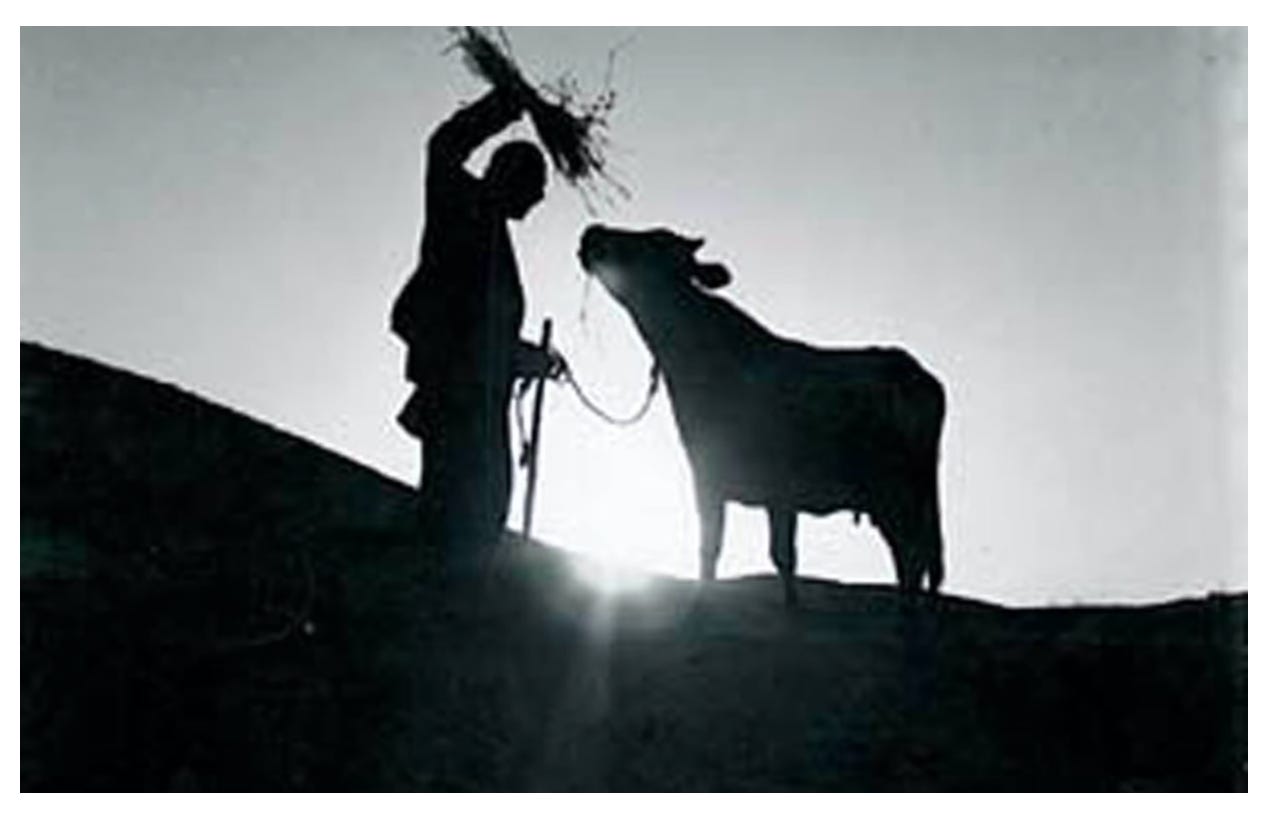
This trailer for The Cow (1968) has zero YouTube comments. Another comment has 14. One of the comments is about the director being murdered, which he was at age 83.
The film was banned for a while, and then became an international success. Iranian cinema has a fraught history, and there are some beautiful movies that came out of this country since the 1960s.
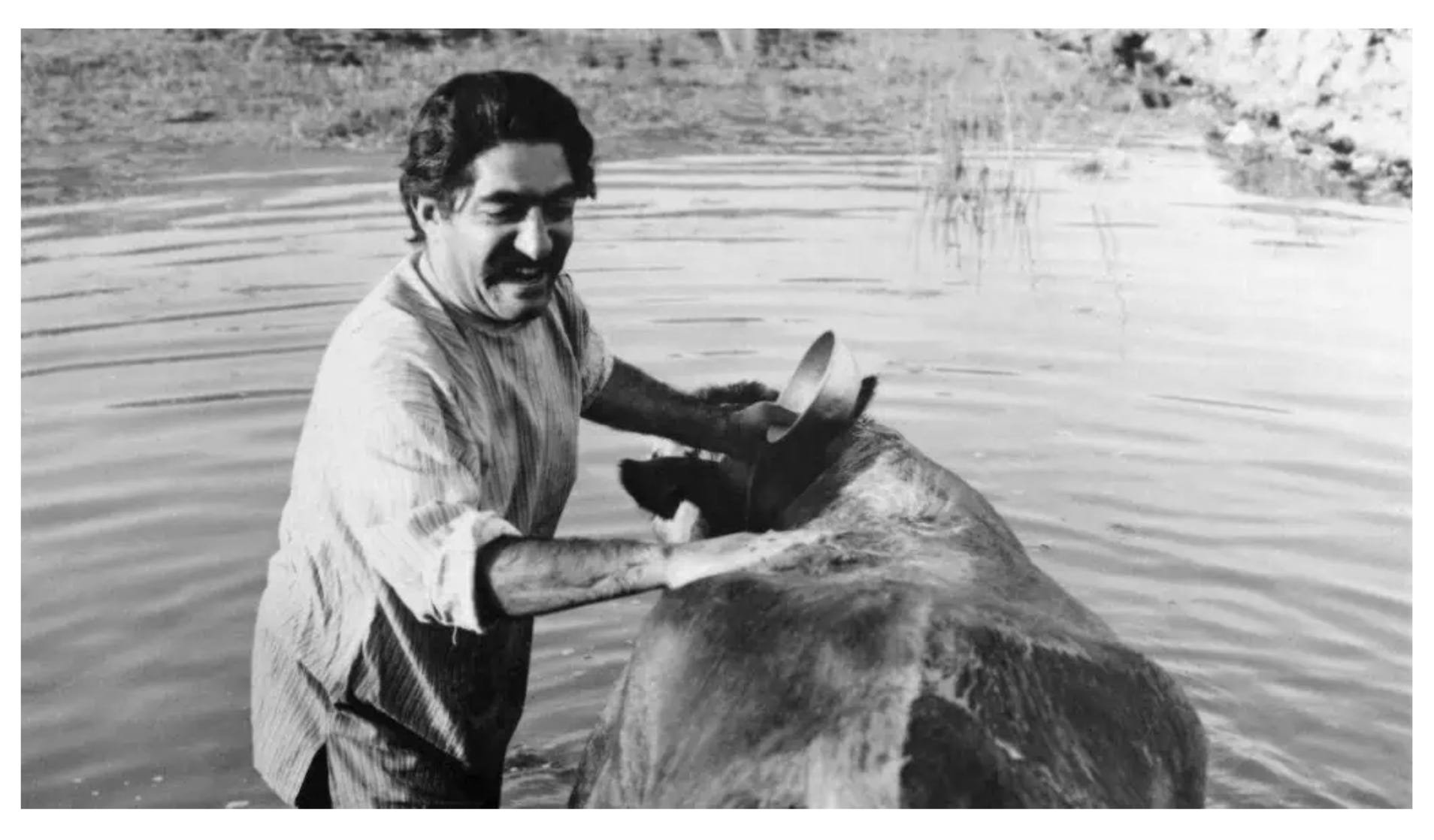
I encountered The Cow while following a syllabus about Iranian film, in which the professor as using Iranian film to explain the Lacanian negative. I didn’t actually get to go to the seminars where this connection to Lacan was ever explained. But watching the films for this class made me a huge proponent of watching international films from different historic periods as a way to change your own relationship to time and space. Different filmmakers from different countries in different time periods really do cut up time, silence, and space differently in the creation of a film.
A lot of people have been pointing out that a lot of videos on Netflix “Feel the same” even though they are on different topics. I think this is a correct observation. One of my antidotes to this feeling around the Netflixification of everything is watching international films.
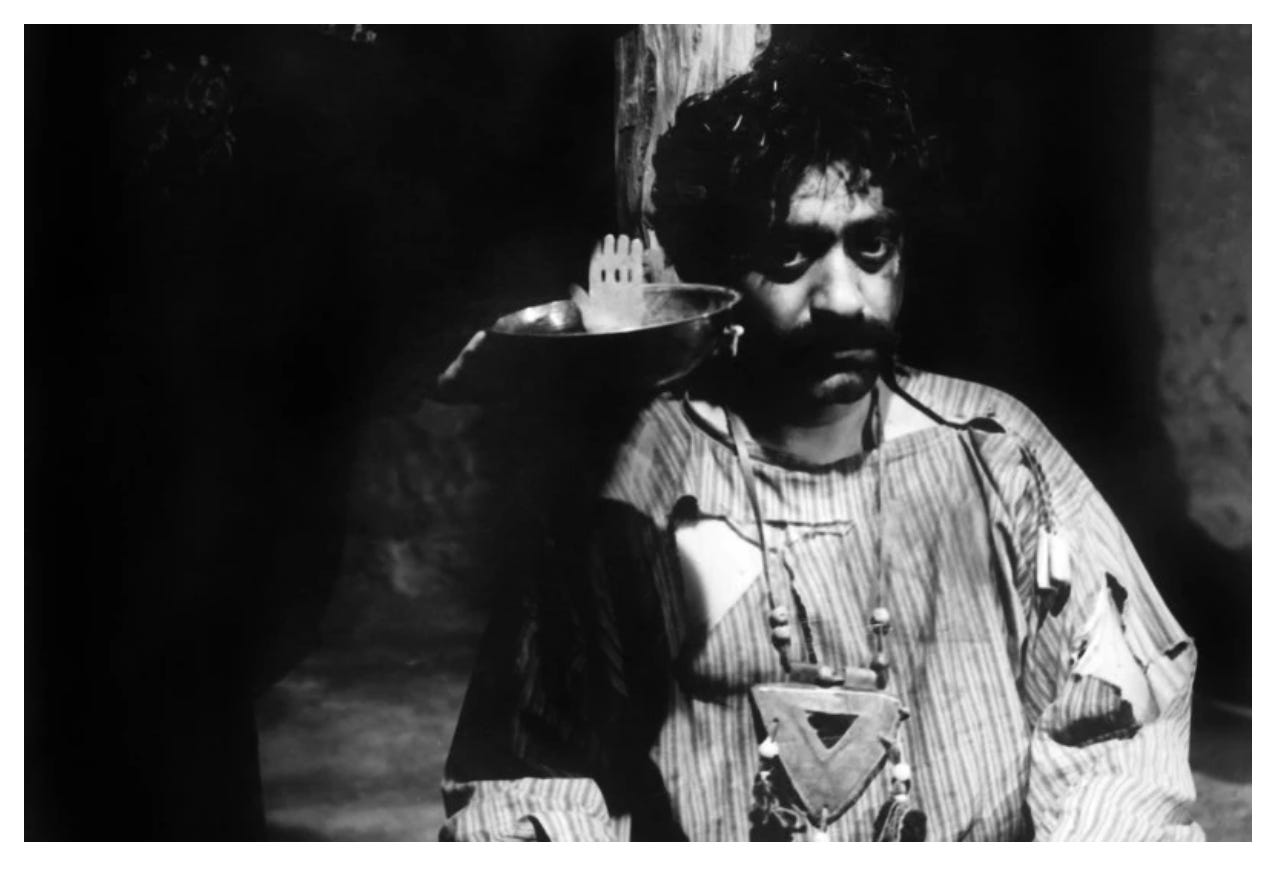
The way I would talk about the film is that it is very simple and beautiful filmmaking. It does something I haven’t seen in movies until I saw it here, and I started keeping an eye on it to see if there are movies where it is done. I haven’t actually found a clear example of this since looking for it, and so The Cow still remains my best example.
When people ask me what I like so much about it, is that, without spoilers, what the movie does is it shows filmmaking as “telling about a thing” through filming people talking, and then filmmaking “showing a thing” by then the film changing to filming what happens as the aftermath of the talking. Imagine eavesdropping on a conversation, and then the people talking about things, and then seeing those things take effect. The movie is formatted like this and does it in a sophisticated way, about topics that are worth talking about. I learned about friendship and human psychology from this film.
The black and white shapes are simple. The dialogue is realistic and straightforward. It depicts a story that is something that actually could happen in real life, and accentuates it so that you are more in tune with reality. This is why I recommend it as a good anti-netflix film to start with, because it is so different that it can serve as an antidote.
There will be a post about other films that I recommend also, many of them also recommendations from this same class.
This comment from IMBD, by JuguAbraham captures an ethos I really like (edited to remove plot elements if you want to be fully surprised)
More of his writing is here:
http://moviessansfrontiers.blogspot.com/
Stunning in simplicity--yet a film that offers food for thought
This is a major work of cinema. It might not be well known but this film ranks with Fellini’s “La Strada”, De Sica’s “The Bicycle Thief,” or Mrinal Sen’s “Oka Oori Katha” based on Premchand’s story--”Coffin.” Why is it a major work? A UCLA graduate makes a film far removed from Hollywood approaches to cinema in Iran during the Shah’s regime. The film was made 10 years before Shah quit Iran and was promptly banned. It was smuggled out of Iran to be shown at the Venice Film Festival to win an award, even without subtitles.
The film does not require subtitles. It’s visual. It’s simple. The story is set in a remote Iranian village, where owning a cow for subsistence is a sign of prosperity. The barren landscape (true of a large part of Iran) reminds you of Grigory Kozintsev’s film landscapes as in “Korol Lir” (the Russian King Lear) where the landscape becomes a character of the story.
[…………………..]
The film stuns you. Forget Iran, forget the cow. Replace the scenario with any person close to his earthly possessions and what happens when that person is suddenly deprived of them and you will get inside the characters as Fellini, De Sica or Sen demonstrated in their cinema.
Every frame of the film is carefully chosen. The realism afforded by the story will grip any sensitive viewer. There is a visually arresting use of a small window in the wall of the cowshed through which the villagers watch the goings on within the cowshed. The directors use of the window serves two purposes--it gives the villagers a perspective of the cowshed and the viewer a perspective of the cowshed watchers.
The film is also a great essay on the effects of hiding truth from society and the cascading fallouts of such actions.
But there is more. Director Mehrjui affords layers of meaning to his “simplistic” cinema. There is veiled criticism of blind aspects religious rituals (Shia Islam), a critical look of stupid villagers dealing with their village idiots, the jealous neighbors, the indifferent neighbors, the village thief--all elements of life around us, not limited to a village in Iran. The political layering is not merely limited to the poverty but the politics of hiding truth and the long term effect it has on society. Ironically, there are values among the poorest of the poor--the hide of a “poisoned?” animal cannot be sold!
I was lucky to catch up with the rare screening of this film at the on-going International Film Festival of Kerala, India, that devoted a retrospective section of early Iranian cinema.
This is a film that should make Iran proud. It is truly a gift to world cinema.