

Consider this: From the inaugural day of Inkhaven’s founding, without a single day’s pause, somebody has written because of Inkhaven. Before each midnight rolled over the Californian coast, the work was done, the promise to write 500 words somewhere on the internet was kept.
On the first of May, I will have written every day for half a year – publishing here for five months of that time.
I was there at the beginning, on November first of the first Inkhaven. In this gray and introspective month I was among the inaugural gathering of writers who had agreed, with varying degrees of confidence, to write five hundred words a day for thirty consecutive days, and to publish them somewhere on the open internet for the world, or at least some small corner of it. It was an experiment. Many of us emerged on the other side changed in ways we had not anticipated and could not name (at least, not yet, without more brooding and more writing).
We have written in bad lighting, at bad hours, in bad auras some truly glorious nonsense. We have written sometimes under pressure, sometimes under duress, sometimes by accident, and sometimes, god help us, completely on purpose: the truth.
With the month’s end visible on the horizon, in the last week of November, some of us began to talk. Not with any formality — in the wandering way that writers talk when they are not willing to admit that they miss the thing they are about to finish. We were sad. The question was simple and unanswerable: what happens next? Some proposed continuing to write into December. Every day, perhaps, or weekly. Some kind of ongoing arrangement — a bet, a game, a curiosity, a dare, an invitation. Who will last the longest? Who will keep writing when nobody is requiring it of them? Will that person end up alright, stronger than the rest, or will that person keel over?
One piece per week felt humane and manageable, and so this is what was agreed on (about half of us did proceed to write on a weekly cadence). I listened to these conversations with the mild and noncommittal interest of a woman watching a ship that she had no intention of boarding depart from a pier. It seemed like a nice idea, in the abstract, but what was the point, really? The month was ending. It was time to fold up our berets, extinguish our structurally-unsound but spiritually necessary cigarettes, which had taken three weeks to figure out how to roll correctly, and return to our normal lives.
And so I did not think too much about it.
On December first, I was free. I remember the feelings of relief, disorientation, gratitude. I cracked open a Guinness. I sat by the fire. I relished the wide open emptiness of an evening that required nothing of me. I could exist without the obligation of turning existence into language.
The more formal bet was based on weekly publication, and so I could wait and see if I wanted to join the bet later.
I finished my drink. I watched the fire, and I noticed, with the reluctant attention of a woman who would rather not notice anything at all, that the tension in my body was not leaving. That the evening, which was supposed to feel like freedom, felt like a room with the furniture moved a few feet in every direction, familiar in its dimensions but wrong in its arrangement.
The thought I had annoyed me: Would it actually be easier for me to write today than not to write?
I sat with that question for a long moment. It was not a comfortable question. I wanted to enjoy my freedom and feel the expected feelings of bliss. The question implied something about the nature of habit that I had not fully reckoned with — that the thing I had been doing every day for a month had not merely been added to my life, like furniture added to a room, but had in some sense become the room itself. That I was, at the neurological level, inside of a thing. And that it was easier to stay inside of a thing than to step outside of it. It wasn’t a trap if I wanted to be in it. But I didn’t know what it meant to be in it.
And so I wrote that night.
The actual article I wrote wasn’t a big deal. It was a silly little article about which of the writing instruments at Inkhaven I will miss and what I plan to do about it when I leave. When I submitted I felt the kind of bodily relief that let me actually relax by the fire the way that I wanted to.
The fact of having written was more important than anything I actually wrote. I wrote that night, and then I wrote the next night, and then the night after that.
When among these days of writing did I have the idea, to publish every day until the next Inkhaven? I do not remember any exact flash of insight. It must have been no earlier than January, after I had done another Inkhaven-month’s worth of writing. After having completed two Inkhaven’s worth of Inkhaven, something about the idea of writing started to change, and so did my relationship to my original source of inspiration and to the original challenge. I was a lot more comfortable. I did not have to prove to myself that I could do it. I was spending more time thinking about the content itself, or about how to make producing the content easier. But there stopped being any question that the writing was worthwhile to be doing, or that I had the capability to do it. I had started having a lot of bad days for unrelated reasons, and the bad days were made better from the writing. I was developing a lot of trust for the process.
“Writing until the next Inkhaven” was an interesting thought because I did not know if there would be another Inkhaven. Its first iteration in November was an inaugural experiment, with an inaugural cohort. It was expensive to run. It was logistically demanding in ways that required specific people to care deeply and work constantly, and specific people are not always available to care deeply and work constantly — they have lives, apparently. Its inaugural cohort had emerged changed but also a little feral, and whether that outcome constituted success depended entirely on who you asked. So "writing until the next Inkhaven" meant, in practice, one of two things: writing every day for approximately a year, or writing every day forever. I decided not to think too hard about which one it was and just wrote my posts like some kind of raccoonish productivity monk, which is to say: consistently, nocturnally, and without much care about personal dignity for the sake of the cause.
The writing was habitual, but it was still hard. I had found ways to make it easier, both with help at Lighthaven when I was there in person, and with [a lot of] help from my friends over at Supercycle, during their own inaugural run of a creativity incubator. It was easier but it was not easy.
I wrote on my phone in Ubers and airports. I wrote at events at which it was inappropriate to be on your phone, while people were talking to me. I wrote late at night in bed before passing out. I wrote every day while losing 5 pounds in one week in February when suffering from a likely norovirus.
I wrote about not wanting to write. There were days that I wanted to give up, but then I kept going by writing about the feeling of wanting to give up. Some of these posts on my most disenchanted days are the posts that my friends like the most. My boyfriend got a whiskey tea as a present, which I stole; I would open it and sniff it like a cracked out possum to set the mood to write when I was feeling particularly angsty.
The hardest days were not when I myself was sick — on those days I could be on my computer for 20 minutes and complain and get a post out. The hardest days were when somebody I cared about was sick. It is hard to write when somebody you care about is throwing up, or you are cleaning up blood again. On those days I would be distracted and most forgetful about the writing. The place inside myself that I can usually tap into would be tangled up in knots.
But the writing helped, and writing every day helped. There was an existential point to the writing because it would not have been bearable to continue to write for so long about things that did not matter to me.
And thinking about writing for Inkhaven — for some reason — perhaps in the future it would be important — it made me happy.
This is because Inkhaven did a lot for me. It did a lot for me because Inkhaven is doing a lot for the spirit and culture of writing generally. It could have been a lot worse as an experiment in writing retreats and bringing back the guild cultures of writing. But it was good, and I wanted to give it something back that was mine to give back.
Writing, like talking, is fundamentally social. The way that I created my blog in the January before Inkhaven, in 2025, was because a friend suggested that my book Mutually Assured Seduction ought to have a blog of the same name. This friend himself started a Substack later that year, The Blackthorn Hedge, in which he started by posting essays that he had distributed to small groups of his friends and peers in years prior, and then proceeded to write new, ambitious essays. One of these essays, The Wet Route to the Stars, is still my favorite essay on Substack today.
The author, John Encaustum, taught me a lot of what I know about writing socially, for real people, for real purposes. Later he wrote up 12 Rules for Madness, another essay I reference often, which started off as a series of texts to me, and then a google doc of me keeping track of the texts. That origin matters — the essay began as one person talking to another, and the form followed from that. It is a model I've come back to more than once when I've tried to understand what writing is actually for.
At the first Inkhaven, a lot of us talked about how it was the first time we were seeing the same people every single day since college. That kind of sustained proximity creates possibilities. What Inkhaven offers that almost nothing else does is the chance to witness a person across time,to see their mood on a Tuesday morning, distracted or tender or agitated, and then to read what they produced that afternoon. Then to see them again Wednesday, angrier or looser or cracked open by something, and to read what came out of that. Over days, a portrait forms. You begin to understand the emotional weather that precedes the writing. It’s an unusually intimate and rare form of knowing someone.
But it is a way of knowing someone that is customary in the guild.
Writer’s guilds were never just professional organizations. They were systems of mutual witness. Apprentices and masters worked in the same physical space, kept the same hours, shared the same materials and frustrations. You learned your craft through prolonged, unavoidable observation — watching someone work when they were inspired, watching them work when they weren’t, learning to read the difference. The knowledge that passed between people in a guild was partly technical and partly a feel for how a serious person moves through the world, how they treat difficulty, what they do when the work isn’t coming. You learn how long things take, how long things are supposed to take. That transmission required proximity, and proximity required space and time.
There is an image of the “lone, tortured writer” — that the artist works alone, accountable to no one, legible to no one, shaped by nothing so mundane as a community of peers. But the history of writing scenes, historically speaking, has been filled with collaborations, duels, psycho-sexual dramas, spectacular fallings-out, letters that were really manifestos, manifestos that were really hate letters. The Bloomsbury Group ate dinner together. The Beats shared apartments and read each other's drafts at 2 a.m. The Paris expatriates congregated at the same cafés. The myth of solitude was always retrospective, applied to the finished work, not the process that produced it.
Inkhaven makes a bet that writers, given the right container, can offer each other something the solitary model never could. It is a bet that I believe in.
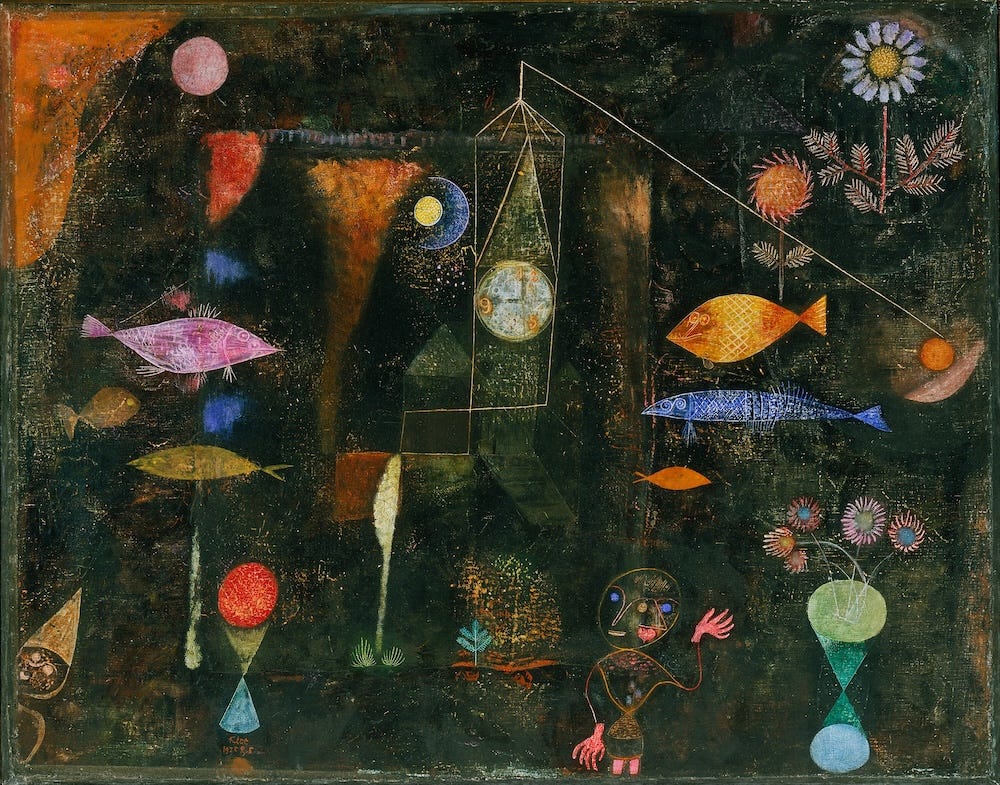
In Writing a Drawing of a Fish, I reveal that I am in disposition more of a visual artist than a writer. I do not think in words or in sentences, as some people describe doing. I do not read fast. I do not pick up vocabulary easily. I think in images — fractal image shapes, often all at once. I get overwhelmed by the images in my mind. I have vivid visual dreams. This is worth saying, because my love of writing and its practices does not come from natural intuition or natural talent.
I did not “want to be a writer.” I wanted to be an artist, I wanted to be a mathematician, and I wanted to not be alone. I wanted to learn how to talk to other people which for a certain level of precision necessitates learning to write. The person who inspired me to write and who showed me that entire categories of writing are possible is the author of An Algorithm is a Camera, who I met in 2012. I heard him give a very charismatic and complicated persuasive speech on behalf of someone being blocked from joining an organization on a technicality — the kind of technicality the organization kept private and served none of the organization’s actual purposes, and that could close a door forever on someone who thought they had done everything right and was never told otherwise.
I was impressed. He was soulful, and he spoke from the soul — and he was skillful enough that his words passed the organization’s rigid standards for technical speech and decorum. They let the guy in. He put words to what I had only felt in a wordless dark pit in my stomach: that something wrong was about to happen to a real person’s honest and sensitive feelings of belonging, and that this wrong was going to go unchallenged because no one had found the words to challenge it yet.
I did not want to “become a writer.” I wanted to learn to “do what he does.” For a few years, I thought that English PhD departments were the places that taught people to “do what he does” and I regretted not spending more time inside of one. I later learned that as in many circumstances, the institution supports or gets in the way of whatever existed for the person that was entirely their own; it does not create it. What I thought was alive and well in the guilds of academic English I would learn is quite threatened. What I felt inspired by was really rare.
And so when I had found Inspiration at Inkhaven, it felt like I had found something quite rare. I had recognized that I found something I was looking for, without knowing I was looking for it or that it could have a name.
I treasure my writing mentors with all my heart — the people who showed me the thing was possible, who handed something forward without knowing exactly who would catch it. I understand that this is what the tradition of writing actually is: a chain of people who carried a flame and then, at the right moment, passed it.
If there is going to be a Foreverhaven, it will be because each night, one of you accepts the passing of the torch. One of you feels the call.
From the inaugural day of Inkhaven’s founding, without a single day’s pause, somebody has written without fissure in the edifice of the Foreverhaven.
This tradition can be kept alive by ordinary people on ordinary nights who simply decided, one more time, that it was worth keeping.
That decision is available to you right now.
What I am telling you is this: the chain has a next link, and it is waiting, and it should be you. Write until the next Inkhaven.
I want to be precise about what I am asking.
I am not telling you to find your voice. I am not telling you that you have a story worth telling, though you probably do. I am not telling you that writing will heal you, or transform you, or make you interesting at parties, though it has done all of these things for people I know and will do them for you too.
I am telling you to keep writing every day until the next Inkhaven.
On April First — that day of fools, though I meant it in earnest — I laid down my pen here; let somebody else take on the torch, and keep it going. What is a haven that depends upon one soul? Let the flame be passed. Let it burn in other hands. Only thus does it prove itself eternal.
What do you get from accepting the call? Here is what the call gives back. It gives you a record of what you were thinking and feeling and noticing on the nights you showed up, which turns out to be more valuable than it sounds when you are standing six months forward from where you started and you can read back through what you made and see, with some astonishment, how much of it was very true and how little of it you would have remembered. It gives you a community of people who know something real about who you are. It gives you, most privately and most durably, a version of yourself that you did not actually perform for anyone, the version that showed up at the bad hours in the bad moods and made something anyway. That version of you is worth knowing. The only way to meet that version of yourself is to do it.
You will become disciplined. You will find a new way of engaging with your life. You will find richer ways of deriving meaning from your experiences. You will realize a continued faithfulness to what you care about.
Writing every day does not make you a writer. It makes you a person who tries to see differently.
You do not need to be good. You do not need to know what you want to say — in fact, if you already know exactly what you want to say, you are probably not ready, because the writing that matters most is the kind that surprises you, the writing that was once the wordless dark pit in your stomach. You cannot plan for that. You can only show up often enough that it has somewhere to go.
Five hundred words. Published somewhere on the open internet. Before midnight. That is the whole rule. It is a low bar and it is the only bar that matters, because the bar is not about quality. The bar is to cross the gap between intending to write and having written, which is the only gap that a tradition can be built across. Every person who has ever kept the Foreverhaven has crossed that gap on a night when they did not want to. On a night when they were tired, or sick, or sad, or simply empty. They crossed it anyway. The Foreverhaven held. And on the other side of that night was another night, and another, and the crossing got easier, not because the gap got smaller but because they got better at jumping.
At the end of Inkhaven, you will have written successfully every day for one month. There is a version of you that has been writing for six months. That version of you is not a different person. They simply did not stop.
The Foreverhaven is not a place. The Foreverhaven is the condition that obtains when enough people have decided, independently and on enough consecutive nights, that the thing is worth continuing. It cannot be built from the top down. It can only be grown from the inside out, one post at a time, by people who felt the call and answered it before they had fully decided whether they were the right person to answer. Foreverhaven continues if on every night, somebody from any cohort of Inkhaven writes. But this duty has to be distributed, and guaranteed. The best way to guarantee Foreverhaven is for somebody to write every day in between Inkhavens. That way there will never be an accidentally uncovered day.
The Foreverhaven has held without a single night’s break since the first of November. That is not a miracle. That is a choice, made over and over by people who were busy and full of reasons not to, who made it anyway. That is your choice now.
The people who passed the flame forward mostly did not know who was standing close enough to catch it. It has always worked this way.
The pen is on the table.
The night is not yet over.
Pick it up.
It's been rad to read your output over the past 5 months, for real. And - while I don't post every day, more often than not I'll spend some time each day writing, or editing a blog post.
“I did not have to prove to myself that I could do it […] there stopped being any question that the writing was worthwhile to be doing, or that I had the capability to do it.”
This resonated with me: to me it would mark a developmental transition (e.g. Keegan subject-object) if I would get there as a writer :)