

I realized at some point yesterday that I do not want to write a book about polyamory. Or about relationships, really.
People having relationships — boring. People having more than one relationship — boring cubed.
What I want to write is a book about shapes. Feelings-shapes.

Probably I will have to finish my book about relationships that is the most developed currently, Mutually Assured Seduction: An End to the Sexual Cold War, and have the feelings-shapes book be the natural follow-up sequel to it.
What I want to write is a book about chaos, and how it happens, and about how to spot and name invisible dynamics and feelings.
Maybe it’s about interpersonal dynamics more generally.
How to make this “fun” is still an open question.
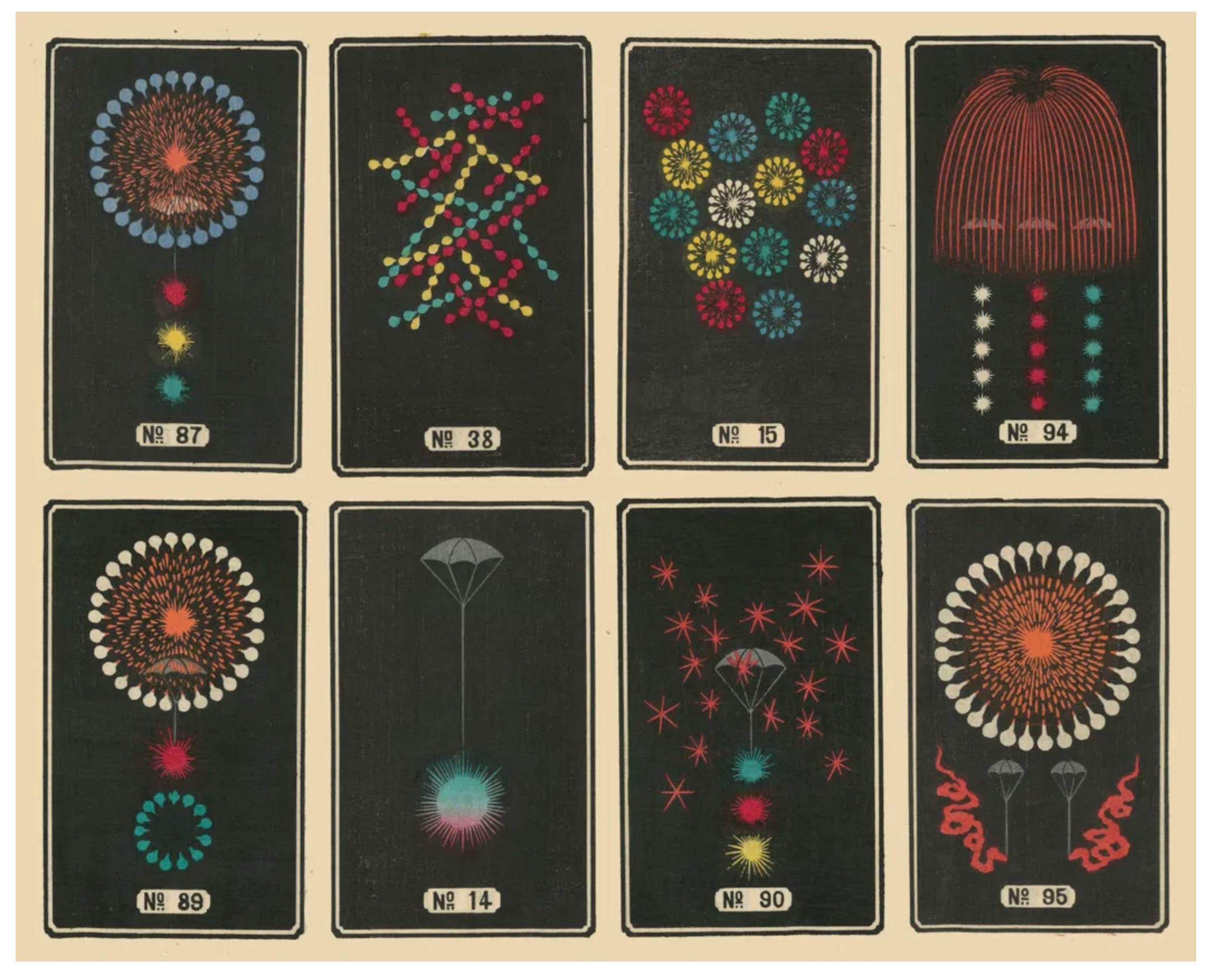
I was thinking about what kind of illustrations I might want for it, and I find myself fairly settled in wanting them to be like the Japanese fireworks catalogs of the late 1800s.
Shapes like this are not far away from my own thinking, and ah! fireworks! What a metaphor!
The whole point is to have fireworks, not cascades of rules. Unless, of course, being bound up by rules is a kink of yours — and there is probably a fireworks illustration for that.
I do not get tired of looking at these images.
The book will probably need a new title. “Poly Playbook” was the original concept. It would be a playful thing, a playbook, not a rulebook, “play parties” are a thing. Cute, right? But then something about it started to bother me, though I still cannot name what it is. Perhaps it is both too cheeky and too authoritative in a ratio that felt off, when I started thinking about “authority” and “cheekiness” as important considerations for the final product.
I like something that the Japanese-style firework woodcuts can be part of a lot more.
But so all of that is vibes. Now I have to take some time and write some of the content today, given it is another day. Yesterday we were talking about cucks. What today?
The point was to write whatever feels alive and exciting, even if my superego thinks it will be boring. If there is enough raw energy there, maybe I can organize it later. But the point is to write what I think is interesting, even if my superego wants to override it, not to write what does not interest me at all because my superego wants me to write something interesting.
I was thinking about something either last night or earlier today. Negotiation, orientation, direction. These are different things.
Say somebody is younger, or new to “the lifestyle” as many people on the east coast may call it. You want to show them the ropes, literally and metaphorically. Negotiation, orientation, and direction are all different things.
Let’s go over them in order of intensity.
orientation is just putting somebody in a situation. Taking them to their first kink party, for example, or making someone an account on Feeld and see who bites. Helping someone choose a picture.
direction is like domming, but without expecting the person you’re directing to be a good sub. That is, you are intentionally not doing anything so complicated that your person will not have to have much situational awareness or be in situations where they need to “guide you to guide them” given that they do not know what is going on and likely do not know what they want. This is the stage after orientation. Maybe you will tell them to wear a specific thing to a party, or maybe you will direct them to do a specific thing with you that you are pretty sure they’d like, in a context where they’d feel pretty safe to easily change the situation if they wanted to. Unlike domming, the point here is to direct your person to a number of choices, so that they could choose and expand their imagination, rather than constricting choices.
negotiation is when you say that somebody can do something, if you get something in return, or when you say that the success of the negotiation will create some sort of a “state change.” In negotiation, it starts to be about you more. You are not guiding the other person to have an experience, or allowing the other person to reveal their preferences. Now, depending on if the negotiation goes well, the other person gets more affordances, but they also could get less.
Okay. Wtf? Why these three terms? Literally this is kind of out of nowhere. That’s not meant to be an insult that’s just literally, okay that popped out of nowhere. Yesterday was cucks, now we get a glossary, okay. thank u, I guess?
Well, what’s exciting to me about these terms is that people get them wrong and get them in the wrong order.
they use them wrong. it causes problems.
this is a fun book about problems because apparently I love problems
But so hear me out.
orientation
direction
negotiation
people mix up the qualities of these pretty badly
You actually have to practice these in a workshop setting. I actually should write up games for each of these. Future me, write the games!
for orientation, a lot of people get really nervous. “I can’t just put this person in this setting” “I can’t just show a person three scenarios and ask what’s their favorite” “I can’t just give a person 3 drinks to taste.”
It misunderstands that people like choice, that people find it delightful to be put in a situation where they are given some options and get to execute agency, that “executing agency with no strings attached” is something people do not get enough of in their life.
for direction, a lot of people get really nervous. “I can’t just tell this person what to do” “I can’t just give this person 2 options and have them choose one” People forget that when there is information asymmetry, being taught stuff can feel really nice
For negotiation, a lot of people get really aggressive without knowing how aggressive they are being. This is the time when “they get to be heard” and “if they agree to the wrong thing they are stuck with it.” It ends up being really high stakes. This sucks.
As you can see from this schema, people lean on “negotiation” and then do it wrong. They are shy about the other two. Just putting a person in a situation, to execute their own will, completely and fully. Or just telling a person what to do. Both let the other person express themselves, show you who they are, show you how they move. In both scenarios if the person likes you, they will probably be trying to please you, unless you give additional explicit permission to not try to please you. And then when you “negotiate” what ends up happening is you end up so preoccupied with your own thing that you shut the other person out without realizing it.
I do think that practicing these three different modes can be really nice for people, and to feel the difference.
You can also tell much more readily which mode is more appropriate, and which is less appropriate, for which situation.
For example, if there is a large information asymmetry, you almost certainly should not be doing negotiation. The other person would be spending a lot of time trying to please you, or trying to understand what is going on. You should stop the negotiation and enter one of the other two phases.
Generally, people overuse negotiation with their loved ones. In part I say “overuse” because a lot of people do not enjoy being negotiated with. Many people do not see it as a site of play. And if it is a site of play, then it shouldn’t have the felt sense of certain stakes that a negotiation would have.
I probably need to crisp this out a lot, and make it an entire chapter.
Probably the book will be, words. which is what a book is. but it might also end up being something like a picture glossary.
Exercises:
Where are you trying to negotiate with someone who has never even been oriented—who doesn’t know the landscape yet?
In what situations would it be more kind to direct (offer structure) than to ask your partner to co-lead when they have no map?
How often are you smuggling tests and power plays into negotiation (“if you really loved me…”) instead of admitting that you want to orient or direct?
When a newbie partner says “yes,” is it curiosity or consent—or are they afraid of disappointing you?
Where have you treated someone’s curious yes as blanket consent for a whole lifestyle?
Are there topics where your partner cannot safely say no without risking the relationship—and can you admit that to yourself?